Friday, September 08, 2006

Speaking for Monet


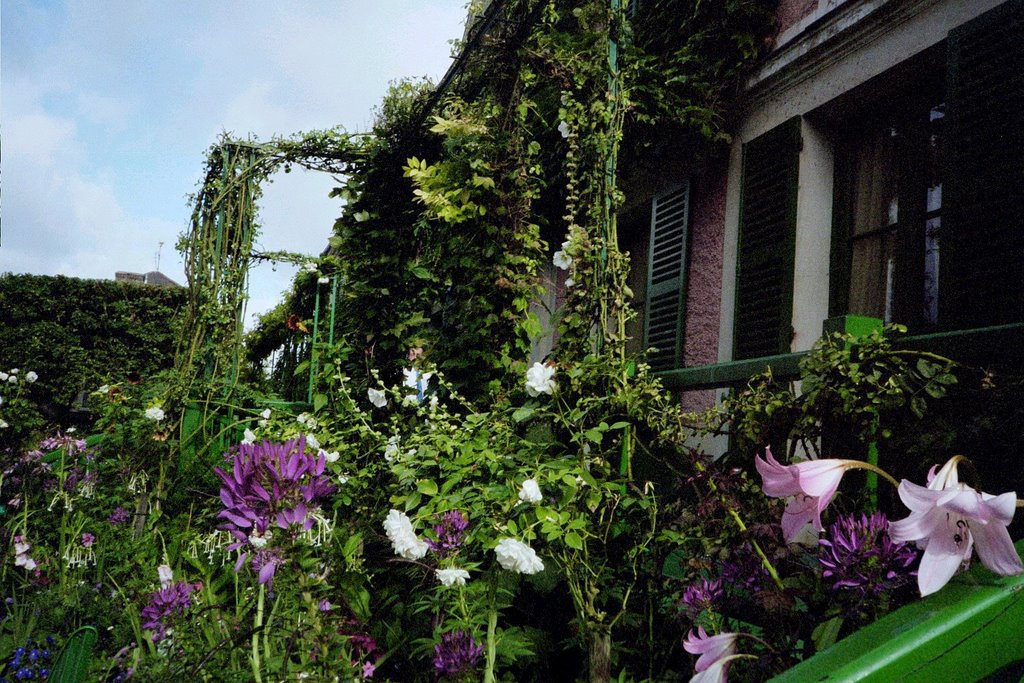
Monet House, Exterior, Giverny, France


"I paint because there are flowers in the world." These are the paraphrased words of Claude Monet, renowned artist and superstar of the Impressionist Movement of painting. His famous works are displayed in all of their splendor at Paris' Orsay, Marmottan and Orangerie museums. To see a LOT of Monet's works in one place, those are the places to go.

If not in Paris, we can savor the beauty of one, or a few, of his paintings in virtually any large museum in the world. His legacy of art speaks for itself, worldwide.

In addition, the house and gardens that provided the environment for so much of his work are today a sort of Monet museum unto themselves. The vibrant colors throughout the house and garden beckon to current-day visitors in the same way that they spoke to Monet over 100 years ago.


Recently, I discovered a book that took me back, on a virtual visit, to the Monet house and gardens in Giverny, France. Color photographs leap from pages, splashing vivid memories of gardens, dining room and kitchen onto my reminiscing mind's eye!

How stunning, to be in Giverny, a short ride from Paris, in Monet's Garden. It is a place that draws you in and helps you to FEEL those words of Monet's about flowers. In the shimmering light, always so intriguing to the artist, the landscape still seems to be calling out to be painted.

MONET'S TABLE, by Claire Joyes, Simon and Schuster Publishers, 1989,takes us to yet another dimension of Monet's world. He appreciated cooking -- loved it, in fact, enough to create his own collection of cherished recipes by persuading his family and friends to commit them to paper. The recipes, like Monet's interests, reflect international dishes and ingredients. Just as so many of us do today, he returned from international trips with a headful of favorite food memories -- and often, a handful of recipes.

Recipes from A to Z, from appetizer to dessert, have been selected by Monet's descendants from his collection and compiled by Claire Joyes, the wife of his great-grandson, in this delightful book. Imagine the aromas of these dishes, wafting through the rooms of the charming house in Giverny. Visualize steaming plates being carried to the dining room table, set in its tones of yellow and blue, harmonizing beautifully with the chrome-yellow walls, creamy-yellow chairs and blue-toned Japanese-art-prints decor of the dining room.

All of that imagining is facilitated, of course, by the multitude of photographs of garden, house, foods and handwritten recipes in the book. Fortunately for we cooks, the recipes have all been translated into English, converted into American weights-and-measures by well-known French chef Joel Robuchon, and faithfully word-processed so that we won't have to struggle to read the rather artistic handwriting of the original collection (even if we could read French!). How delightful, though, to be able to see an original, yellowed, recipe page from the master artist's kitchen.

Bringing to mind, once again, how much charm -- how much of the real person -- is brought to bear by the handwritten word. Somehow, it's hard to imagine future generations looking at a USB memory stick of great grandmother's recipes and exclaiming, "Oh, can't you just SEE her at the stove?" (Yes, I CAN hear you saying, "Put a photo of grandma on the memory stick with the recipes!")

Monet lived to a ripe age and spent most of his years surrounded by an extensive family and many friends. The weekend meals in Giverny, especially in the summer, included many art, government and literary friends from Paris and abroad.

At that time, Monet spoke to the world in his art, through his gardens and by means of his devotion to shared food. By means of all three of those elements, that legacy continues. Today, as then, his art, Giverny gardens and recipes all speak for Monet.

Saturday, August 12, 2006

Peaches and Herb - Revisited


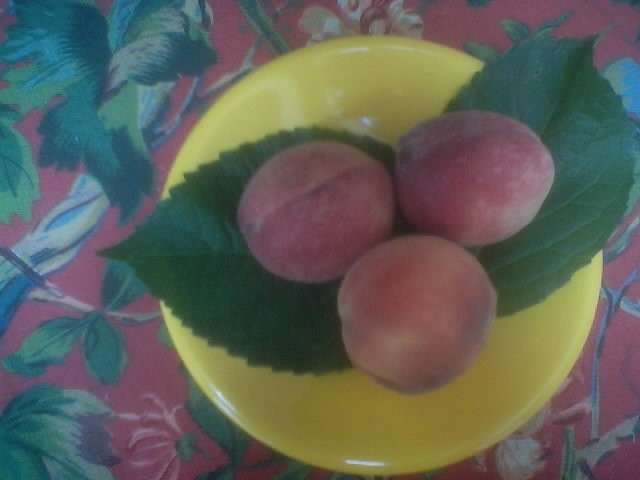
White, Freestone Peaches


Trivia Question:

What pop group from the 1960's and 70's earned the nickname "Sweathearts of Soul" with hits like "Let's Fall in Love" and "Close Your Eyes"?

(No guesses? Or are you one of those clever people who knew the answer right away?)

Here's a Hint:


The answer is food-related! And no, it's not the Beatles -- even as gregarious an eater as the Ingredient Sleuth hasn't termed beetles (and it's spelled with an 'e' rather than an 'a' anyway) a food just yet!

(Give up?)

The Answer:


Peaches & Herb!


If you've finished groaning, after that introduction, we can proceed to the topic at hand -- peaches! Here we are, well into the depth of summer (ask anyone in the hot zone that seems to exist everywhere in the Northern Hemisphere this year), and peaches are available in all of their juicy abundance.

Originating in China, then migrating along the ancient Silk Road to Persia and the Mediterranean by 2000 B.C., the pretty, pink blossoms of peach trees now grace fields and back yards worldwide. Where blossoms glow, peaches grow!

As modern cultivars, peaches are typically classified as either "cling" or "freestone" based on the characteristics of the peach flesh surrounding the stone. In cling peaches, the flesh clings to the ridgy-surfaced stone; in freestone peaches, the flesh pulls away cleanly from the stone.

Many say that cling peaches are sold primarily for commercial canning purposes, and, as a result, do not appear routinely on grocers' shelves as fresh fruit. I find that NOT to be true, however.

Many times, after making a nice, slick cut around the circumference of the peach, then doing that opposite-direction turn of the two halves, I grimace as I discover that the peach is as tightly attached to the stone as before I made the cut! A Cling Peach! I then proceed with more cuts, wedging off thin slices of peach, one by one. Still just as delectable, albeit a bit more drippy -- and best not tried if the consumer is wearing long sleeves -- the peach slices eventually find their way to mouth or serving dish.

Freestone peaches are simpler and much better for lunch boxes, picnics, and virtually all applications, in my way of viewing the world (in which I prefer dry wrists to peach-juice wrists!). The flesh of the peach slips easily away from the stone and is ready for use without delay.

The flesh of the peach, in both cases, may be either yellow or white. Those with a true sweet tooth will likely prefer the white-fleshed varieties; the yellow varieties typically provide an extra little acidic tang.

Both yellow- and white-fleshed peaches often have red on their skin. As a result, peach identification, at the market, is best accomplished by faithful reading of the grocer's signage -- and perhaps of those pesky little glued-on stickers.

Today's recipe makes splendid use of freestone peach halves. From the recent cookbook by Jerry Traunfeld (HERBAL KITCHEN: Cooking with Fragrance and Flavor, William Morrow/Harper Collins Publishers, 2005), the recipe develops the flavors of the peaches by roasting and enhances them with the zing of herbs, nuts and sugars.


Roasted Peaches filled with Almond and Tarragon
(8 servings)

6 tablespoons unsalted butter, softened
¼ cup sugar
¼ cup dark brown sugar, packed
1 large egg
¼ cup plus 2 tablespoons all-purpose flour
1 tablespoon coarsely chopped tarragon
¾ cup sliced almonds
4 large ripe freestone peaches

Preheat the over to 400 degrees Fahrenheit. Beat together the butter and both sugars in a mixing bowl with a wooden spoon, or in an electric mixer, until there are no lumps. Beat in the egg and then the flour. Stir in the tarragon and almonds.

Split the peaches in half and remove the pits. Arrange the peaches cut side up in a shallow baking dish just large enough to hold them. Divide the almond filling into 8 equal portions and mound each in the cavity of a peach half. Bake for 30 to 40 minutes, or until the filling spreads over the top of the peaches and becomes well browned and crisp. Cool the peaches slightly. Serve them warm in shallow bowls with whipped cream or vanilla ice cream.

Herbal improvisations: In place of the tarragon, add ¼ cup chopped anise hyssop leaves. Fresh green fennel seed is also good in this dessert; use 2 teaspoons chopped soft seed.

** NOTE: This recipe was authorized for reprint by the Ingredient Sleuth with the express permission of the author, Jerry Traunfeld, and the publisher.

The pleasing blend of flavors in this dish seems to me to be in complete harmony with the concepts of yin and yang of peaches' native China! The balance of all the flavor components is simply grand. And the caramel-crisp nut/herb topping is eye-rollingly luscious!

Eating these peaches while they are still warm is heavenly. Oozing-sweet peach juice, melted butter-caramel, roasted-rich nuts and bright, slightly-licorice fennel -- flavor explosions, texture contrasts. A dish that made my mouth water WHILE I was eating it! Every bite called for another.

The HERBAL KITCHEN cookbook is grand, as well. Mr. Traunfeld grasps the concept of HOW we gardeners -- especially herb gardeners -- cook! He knows that we eyeball our herb beds/containers/windowsills and think, "Hmmm, I have a lot of lovely tarragon right now. I wonder how I should use it."

Then, we pull down a cookbook from a shelf and start browsing. In the HERBAL KITCHEN, not only do we find recipes, sweet and savory, that make wonderful use of herbs but also a quick, ready reference for answers to our herbal cultivation questions.

What herb gardener, somewhere along the way, hasn't asked himself, "I need to harvest some of that oregano. Now, do I cut it WAY back, or only halfway down the stem." Most of the time, I find answers to such gardening questions much more easily in the HERBAL KITCHEN than in a gardening book. This is not surprising, I think, simply because Mr. Traunfeld is a chef. He knows what we "cookers" are thinking!

As the head chef at The Herbfarm Restaurant (http://www.herbfarm.com/) in Woodinville, Washington, for over 15 years, Jerry Traunfeld creates herb-inspired Northwest menus each week. He has received the James Beard Award for Best American Chef in the Northwest and Hawaii.

Was it a favorite song from Peaches & Herb that inspired this delectable dish? Likely not, though every time you prepare Roasted Peaches filled with Almond and Tarragon, you may find yourself humming "Let's Fall in Love" -- mentally adding, "With peaches and herbs!"

Monday, July 31, 2006

Got Bottles?


Early morning breezes ruffled the hair of the milk-man as he walked through the neighborhood. As he (were there ever any milk-women, inquiring minds want to ask?) moved from house to house, and from truck to sidewalk, the jingle of glass bottles accompanied his every step.

Jangling in two pitches, the milk bottle sounds came forth in the bass range for full bottles, and in high-alto/low soprano for the empties! The sound of house doors opening, then closing, in harmony with their own sets of bottle jingles, followed quickly upon the milk-man's departure.

Was it really so very long ago that these sounds were heard throughout the land? In fact, the answer is an emphatic "No!" Even now, in some neighborhoods, the milk truck arrives at the door with fresh dairy products. Sadly, these neighborhoods are no longer common.

Recently though, there has been a resurgence in the availability of the distinctive flavor of milk in glass bottles. After decades of residence in wax cartons and plastic jugs, milk has once again appeared on store shelves in bright-and-sparkly glass bottles.

In southern California, the Wild Oats, Henry's and Whole Foods grocery chains now offer glass-bottled milk, from nonfat to whole and steps in-between, on a regular basis. Sometimes, even raw (gasp! AND hooray!), unpasteurized milk is offered.

Prompting this question in the Ingredient Sleuth's brain:

"Do people really KNOW how GOOD milk in glass bottles tastes?" Or have we forgotten what the REAL THING really has to offer?

In these times of renewed interest in sustainability and organics, both for preservation of the environment AND because foods just plain TASTE so much better in their fresh and unaltered states, people seem to be in a process of rediscovery.

That white beverage in the glass bottles does seem to have a flavor that is uniquely its own. Even in its lowfat versions, there is a depth of flavor -- and a pleasantly-sweet component -- that is hard to duplicate.

Hmmm, let's see, what does it remind me of -- just there, at the tip of my tongue? Ah yes! Sweet-and-fresh butter, honeyed ice cream, pungent cheeses. So THAT'S how all those good things come to taste so delicious. (Another one of those "well duh" moments, in the making!)

They are made from milk!!! Not that imitation stuff, sort of a scaled-back version of itself, that has stood around in waxy or plastic-y environs for days and days and days. But real, fragrant, wholesome milk, just as as the cow made it for us. Meant to be enjoyed sooner, rather than later, without contact with artificial flavors of any kind.

As a treat, even if not for every day -- and sometimes even in place of ice cream -- this Sleuth likes nothing better than a tall, ice-cold, glass of the REAL THING! THEN, and only then, one really can say "GOT MILK!" And perhaps, play a little xylophone-like song on the bottles as well!