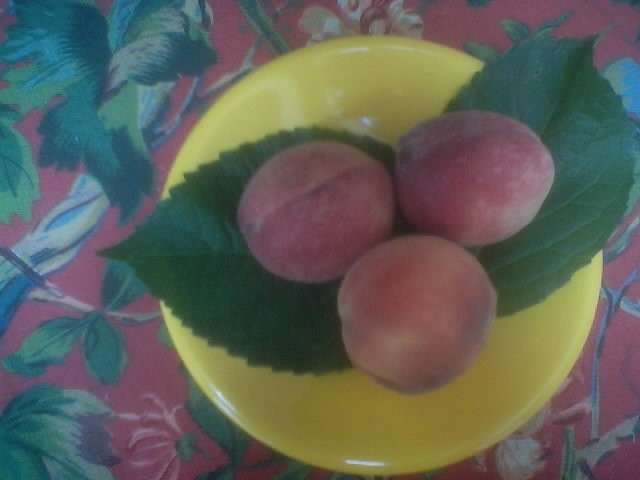
The sun was shining, the birds were singing and the swimming pool was shimmering. Granted, it was just an inflatable, child’s wading pool, of light blue plastic. But it was a pool nonetheless; it even had a tiny diving board, perfect for a quick dip!The first jump of the afternoon was by Rachael Raisin. Her skin, though a bit wrinkled, glistened as she stood on the board, sun reflecting all around. She hit the pool with a tiny splish-splash, then trilled in her even-tinier voice, “Fire!”Next up was Alfonso Almond, the jokester who, even at his young age, always had something incongruous to say. The diving board was slippery for him, but he stood gallantly at the very tip of it, twisted his golden-brown body as he slipped (more than dove) toward the pool. “Fire!” he called, sounding even nuttier than usual.Finally, Amanda Apricot struggled onto the board. Her well-rounded body was not well-suited to diving boards. But, she rolled painstakingly to the end of the board, wobbled left, then right, and finally careened off the side of the board and into the pool at its very rim. “Fire!” she murmured, as she realized that she was merely waist-deep – in chocolate!As Rachael, Alfonso and Amanda dried off later, in the shade of the patio umbrella, the lifeguard had to ask, “Why did you all yell ‘fire’ when you jumped into the chocolate?” And then, even before they answered, she knew the response. It had to be the old record album that she had found at the flea market yesterday and played repeatedly in the evening. The Smothers Brothers had sung a catchy little tune, about falling into the chocolate and yelling “fire.” Why? Because, they sang, no one would have saved them if they’d yelled, “Chocolate!”In fact, if they had yelled “chocolate” everyone would probably just have gotten up from their chairs and headed to the store to buy some! Or strolled to the pantry to retrieve some. Or found giant spoons, dipped into the chocolate pool and started eating! The world often seems as immersed (mentally, at least) in chocolate as Amanda Apricot. The mere mention of the word seems to create a
mesmerizing craving. How did this come to be? When? Where? How?
Those are the questions that are answered by a fascinating,
traveling exhibit of Chicago’s Field Museum (
http://www.fieldmuseum.org). I saw the “Chocolate” exhibit recently, in San Diego, and learned many things about this most-enticing of ingredients. (Currently, the exhibit is in San Francisco, will move on to Milwaukee in October, and to Atlanta next February.)
Cacao trees thrived in Central America as early as 200 A.D. Their seeds, thirty to fifty of which are contained in each acorn-squash-sized (but skinnier)
pod, are about the size of an almond. The purple-white
seeds are wet when removed from the pod, turn brown after being exposed to the air, are dried and then are ready for further processing.
From 250 to 900 A.D., a
bitter, white drink that the ancient
Mayans created with the beans was moved northward; the march of chocolate had begun. The cacao beans became known, and valued, among peoples of the region. As the beans’ perceived value grew, they themselves served as currency for the Aztecs in a kind of semi-bartering arrangement. Perhaps, the budding chocoholics of ancient times couldn’t resist consuming their currency, rather than spending it on other purchases, when a craving struck!
In the 1600s,
Spanish explorers, especially Hernan Cortes, carried cacao beans to Spain. That was when the true magic, at least as perceived by we modern types, began. The Spanish added sugar, creating a sweetened drink, and chocolate’s future appeal was guaranteed! Over the years that followed, people throughout Europe would develop varied methods of using the sweetened mixture. Processing (from roasting through grinding, pressing, refining and tempering) would come to bear so that chocolate, in all of its liquid and solid formats as known today, could spread its flavors throughout the world.
Over time, the 30 to 50 seeds contained in each pod of the cacao tree would come to produce enough chocolate for seven chocolate bars, as we know them today. Gazing at the cacao tree, with pods, on display in the museum exhibit, I immediately did the mental translation into seven times as many chocolate bars, suspended there from the tree’s branches! Visions of sugar plums, dancing in my head, yet again!
The exhibit also features many of the
accoutrements that have grown up around the use of the tasty cacao bean. Serving vessels from ancient times, hot-cocoa porcelain sets from Europe’s finest makers, early Easter-bunny mold forms from the 1890s and, my personal favorite, a 1920s to 1940s Hershey candy bar vending machine with per-bar pricing of ONE CENT! (Sigh.) The exhibit also includes its own gift shop, allowing exhibit-goers to emerge from the viewing with chocolate in-hand (although not priced at one cent) to satisfy the craving.
Further detail about chocolate production and its processing, recipes and enough colorful photographs (over 600) to send one straight to the store or pantry are contained in
THE CHOCOLATE BIBLE, a book by Christian Teubner (et al), Penguin Studio Publishers. Especially intriguing, to me, is the concept that cacao beans from various tree varieties, various parts of the world, and various seasonal climatic conditions, have unique flavors. These flavors are
blended, to produce specific chocolate profiles, just as varying grapes are blended for wine and diverse coffee beans are combined for coffees. Recipes for the use of chocolate as an ingredient, from cocoa to chips to melted bars, abound.
A currently-popular concept seems to be the coating, or partial coating, of
nuts and dried fruits with melted chocolate. Tree nuts, as well as peanuts and the (legume) soy nut, are routinely available in chocolate-coated formats. Dried fruits also provide a wonderful blend of flavors when paired with chocolate. A quick Internet search confirmed what I have noticed at my local Trader Joe’s store (
http://www.traderjoes.com/), which has an excellent selection of chocolate-coated dried fruits -- the pairings seem endless! Raisins, apricots, blueberries, cherries, cranberries, ginger, blackberries, raspberries, strawberries, orange peel, pineapple – all are available in a dizzying array from Internet purveyors.
In addition, the windows of those exclusive
chocolatier shops that one sees, around-and-about the world, these days also reflect the nuts and fruits trend. An increasing number offer thin bars or bite-sized disks of chocolate, on which are placed several beautiful pieces of fruit slices and nuts in an artistic arrangement. In keeping with the chocolatier tradition, they are ALMOST too pretty to eat! I am proud to state that I overcome that barrier, however!
We
“do-it-our-selfers” can go wild as we decide which nuts or dried fruits to dip into the glistening melted chocolate – albeit not with the use of a wading pool! Maybe we like the idea of coating each whole item, individually. Maybe we like to form little clusters of one item, or a custom combination of items, and drop them by the teaspoonful onto parchment paper to dry. Maybe we like to create little half-moon areas of chocolate coating (like little chocolate hats!) at one end of the nut or fruit, creating colorful delicacies to accompany a dessert of ice cream. In any case, the crunch of nuts and the sweet, soft, flavor explosion of fruits combine to create a taste and “mouth feel” that embellishes chocolate’s rich smoothness.
As long as there is opulent, lovely chocolate, and as long as people are drawn to it by the multitudes, the
dipping will continue. Each item, headed for its plunge, may not call out “Fire” as it is adorned with its crowning glory. More likely, the brain of the participating cook will call out “Chocolate” with each item’s dunking! And then, at last, the cook will finish the work, clear up the work surface, and do the obvious --
indulge! Bon appetit!