Showing posts with label Fruits. Show all posts

Thursday, February 24, 2011

Pomegranate "How To"


We hear and read more and more about the health benefits of pomegrantes. But I sometimes wonder if that fruit, in its normal, fruit-like dimension, isn't one of the most-ignored fruits in the market. I can imagine them saying "Choose me, choose me, please" and then sighing dejectedly as yet another shopping cart and customer moves on to the next display -- the customer with a puzzled look on his face.

So here we go. Let's pick one up ... a nice heavy one so that it has lots of the precious seeds. And let's take it home with us and dig in!


Digging in is actually quite the correct concept. We don't bite into it -- ouch! It's the seeds that we're after. In fact, with just a tiny bit of juice for the seeds to live in, and lots of white pithy substance, that's all that's inside the pretty, deep-red fruit.

First we cut off the stem end. That was easy.

Next we cut the fruit into halves, and then those halves in half so that we end up with quarters. Pretty easy too.


And then we just dig in! But first we dive in. Yes, removing the seeds while each quarter is immersed in a container of water is an easy way to separate the seeds from the pulp bits. The seeds sink to the bottom and the pulp bits float.

Thumbs work particularly well to get at the seeds, releasing them from the white pulp with ease.

After all four quarters have been completed, you'll have about two small handfuls of those precious pomegranate seeds.


And you'll have several big handfuls of pulp to be discarded.

Unless I am making a particularly-large salad for a big group of people, I like to use the seeds a few tablespoonfuls at a time. They freeze beautifully ... just spread them in a single layer on a tray in the freezer for a few hours. Then, package them up for future scooping. A small, glass jelly jar is just about the right size and keeps them nice-and-fresh in the freezer.

So now, when those pomegranates come calling in the supermarket, maybe they won't have to feel like the wallflowers at the school dance any longer?

Saturday, August 12, 2006

Peaches and Herb - Revisited


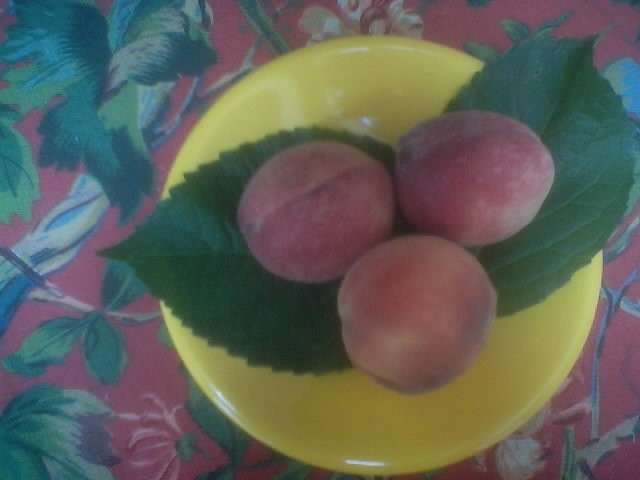
White, Freestone Peaches


Trivia Question:

What pop group from the 1960's and 70's earned the nickname "Sweathearts of Soul" with hits like "Let's Fall in Love" and "Close Your Eyes"?

(No guesses? Or are you one of those clever people who knew the answer right away?)

Here's a Hint:


The answer is food-related! And no, it's not the Beatles -- even as gregarious an eater as the Ingredient Sleuth hasn't termed beetles (and it's spelled with an 'e' rather than an 'a' anyway) a food just yet!

(Give up?)

The Answer:


Peaches & Herb!


If you've finished groaning, after that introduction, we can proceed to the topic at hand -- peaches! Here we are, well into the depth of summer (ask anyone in the hot zone that seems to exist everywhere in the Northern Hemisphere this year), and peaches are available in all of their juicy abundance.

Originating in China, then migrating along the ancient Silk Road to Persia and the Mediterranean by 2000 B.C., the pretty, pink blossoms of peach trees now grace fields and back yards worldwide. Where blossoms glow, peaches grow!

As modern cultivars, peaches are typically classified as either "cling" or "freestone" based on the characteristics of the peach flesh surrounding the stone. In cling peaches, the flesh clings to the ridgy-surfaced stone; in freestone peaches, the flesh pulls away cleanly from the stone.

Many say that cling peaches are sold primarily for commercial canning purposes, and, as a result, do not appear routinely on grocers' shelves as fresh fruit. I find that NOT to be true, however.

Many times, after making a nice, slick cut around the circumference of the peach, then doing that opposite-direction turn of the two halves, I grimace as I discover that the peach is as tightly attached to the stone as before I made the cut! A Cling Peach! I then proceed with more cuts, wedging off thin slices of peach, one by one. Still just as delectable, albeit a bit more drippy -- and best not tried if the consumer is wearing long sleeves -- the peach slices eventually find their way to mouth or serving dish.

Freestone peaches are simpler and much better for lunch boxes, picnics, and virtually all applications, in my way of viewing the world (in which I prefer dry wrists to peach-juice wrists!). The flesh of the peach slips easily away from the stone and is ready for use without delay.

The flesh of the peach, in both cases, may be either yellow or white. Those with a true sweet tooth will likely prefer the white-fleshed varieties; the yellow varieties typically provide an extra little acidic tang.

Both yellow- and white-fleshed peaches often have red on their skin. As a result, peach identification, at the market, is best accomplished by faithful reading of the grocer's signage -- and perhaps of those pesky little glued-on stickers.

Today's recipe makes splendid use of freestone peach halves. From the recent cookbook by Jerry Traunfeld (HERBAL KITCHEN: Cooking with Fragrance and Flavor, William Morrow/Harper Collins Publishers, 2005), the recipe develops the flavors of the peaches by roasting and enhances them with the zing of herbs, nuts and sugars.


Roasted Peaches filled with Almond and Tarragon
(8 servings)

6 tablespoons unsalted butter, softened
¼ cup sugar
¼ cup dark brown sugar, packed
1 large egg
¼ cup plus 2 tablespoons all-purpose flour
1 tablespoon coarsely chopped tarragon
¾ cup sliced almonds
4 large ripe freestone peaches

Preheat the over to 400 degrees Fahrenheit. Beat together the butter and both sugars in a mixing bowl with a wooden spoon, or in an electric mixer, until there are no lumps. Beat in the egg and then the flour. Stir in the tarragon and almonds.

Split the peaches in half and remove the pits. Arrange the peaches cut side up in a shallow baking dish just large enough to hold them. Divide the almond filling into 8 equal portions and mound each in the cavity of a peach half. Bake for 30 to 40 minutes, or until the filling spreads over the top of the peaches and becomes well browned and crisp. Cool the peaches slightly. Serve them warm in shallow bowls with whipped cream or vanilla ice cream.

Herbal improvisations: In place of the tarragon, add ¼ cup chopped anise hyssop leaves. Fresh green fennel seed is also good in this dessert; use 2 teaspoons chopped soft seed.

** NOTE: This recipe was authorized for reprint by the Ingredient Sleuth with the express permission of the author, Jerry Traunfeld, and the publisher.

The pleasing blend of flavors in this dish seems to me to be in complete harmony with the concepts of yin and yang of peaches' native China! The balance of all the flavor components is simply grand. And the caramel-crisp nut/herb topping is eye-rollingly luscious!

Eating these peaches while they are still warm is heavenly. Oozing-sweet peach juice, melted butter-caramel, roasted-rich nuts and bright, slightly-licorice fennel -- flavor explosions, texture contrasts. A dish that made my mouth water WHILE I was eating it! Every bite called for another.

The HERBAL KITCHEN cookbook is grand, as well. Mr. Traunfeld grasps the concept of HOW we gardeners -- especially herb gardeners -- cook! He knows that we eyeball our herb beds/containers/windowsills and think, "Hmmm, I have a lot of lovely tarragon right now. I wonder how I should use it."

Then, we pull down a cookbook from a shelf and start browsing. In the HERBAL KITCHEN, not only do we find recipes, sweet and savory, that make wonderful use of herbs but also a quick, ready reference for answers to our herbal cultivation questions.

What herb gardener, somewhere along the way, hasn't asked himself, "I need to harvest some of that oregano. Now, do I cut it WAY back, or only halfway down the stem." Most of the time, I find answers to such gardening questions much more easily in the HERBAL KITCHEN than in a gardening book. This is not surprising, I think, simply because Mr. Traunfeld is a chef. He knows what we "cookers" are thinking!

As the head chef at The Herbfarm Restaurant (http://www.herbfarm.com/) in Woodinville, Washington, for over 15 years, Jerry Traunfeld creates herb-inspired Northwest menus each week. He has received the James Beard Award for Best American Chef in the Northwest and Hawaii.

Was it a favorite song from Peaches & Herb that inspired this delectable dish? Likely not, though every time you prepare Roasted Peaches filled with Almond and Tarragon, you may find yourself humming "Let's Fall in Love" -- mentally adding, "With peaches and herbs!"

Friday, August 26, 2005


Heirloom Tomatoes from Laguna Hills Farmers' Market Posted by Picasa

Tomatoes of Heritage

The community garden, nestled at the edge of the city, was a veritable beehive of activity. Grandparents talked enthusiastically with each other, proudly displaying visiting grandchildren and garden produce to each other.

One particularly precocious young lad of about ten years of age attentively followed his grandmother’s conversation with her adjacent garden-plot renter. “Oh, we can’t wait each day to see if any of our tomatoes are ready to be picked,” said Grandma. Stooping over to pluck a striped, green tomato from the fuzzy vine that left its pungent aroma on her well-worn gardening gloves, she added, “It’s always such a pleasure to find well-ripened ones.”


The adjacent gardener furrowed his brows. Perhaps Grandma had developed a recent case of color-blindness. Or maybe she had just been out in the sun a little too long. Or possibly she was making a batch of fried-green tomatoes? How could he stop her from picking those still-green tomatoes from their vine-y support system?

The attentive ten-year-old boy noticed the other gardener’s concern. “Oh, it’s alright Mr. Jones,” he whispered brightly, “these are grandma’s green zebras and they’re a heritage!” At that comment, of course, the concerned gardener’s eyebrows shot up to the very top of his constantly-receding hairline! Green zebras? Heritage?


But Grandma and grandson were in completely-correct gardening form. They had researched their topic and were ready, able and competent. In fact, they had spent many happy afternoons together, during the preceding winter as powder-dry snow swirled around the windows, poring over seed catalogues and Internet sites, in search of a half-dozen heirloom tomato varieties for their garden plot.

This year, they were going to get back to basics, focus on the tried-and-true, celebrate some heritage of days gone by. The search was difficult, though. Lack of sources, lack of variety was not the problem – there were so MANY interesting options that it was just so very difficult to choose! They wanted to order all of them!

But, choose they (finally) did and as summer approached, seeds were planted in indoor trays, then seedlings were set out into the garden when the weather was favorable. And, ever since that late-May day, Grandma and grandson had shared a special outdoor project that produced lifetime memories, in addition to glorious tomatoes, that were especially their own -- their memories of heritage!

“The Heirloom Tomato Project,” as their effort was named by the 10-year old, grew out of a visit that they had made to the local farmers’ market the previous summer. As they strolled the wide aisles, they had been captivated by one stall in particular. For, arrayed on the stall’s table, were tomatoes of every description except the usual! In fact, there were none of the usual, fire-red, uniform globes of supermarket fame.

Rather, this display of tomatoes had been slightly reminiscent of a “seconds sale” at the local pottery factory. Rather than smooth, thick skins – the kind that allows supermarket tomatoes to be picked before ripe, then travel thousands of miles from growers, and then sit patiently on the shelf for days, all the while LOOKING lovely but having never developed a full, ripe flavor – these oddball varieties had unusual shapes and fragile skins. They came in all sizes. And there were colors from pink to purple to yellow to green and gold – oh yes, and some reds as well!

The farmer at the market stall had been friendly and smiled knowingly at the grandmother and grandson. He could see the spark of interest in their eyes (those large, smiling brown eyes that so resembled each other’s) and knew that they wanted to know more. Their rapt attention, as he explained the basics of heirloom tomatoes, was very gratifying to him.

The oldest tomato variety in America has been grown consecutively for 600 years. It happens to be a small, pear-shaped tomato that is red in color. To qualify as an officially-designated “heirloom” variety, though, a tomato need be grown unchanged (maintaining the identical size, flavor, texture and color characteristics) for “only” fifty years – in many cases, by the same family. And that of course, is where the “heritage” comes in! Passed from generation to generation, the heirloom tomatoes have been kept in their original form and format -- rather than hybridized or cross-bred again and again to produce those supermarket globes.

As a result, the true flavors, which different significantly from each other, are maintained in each heirloom variety. Some are quite pungent and tart, high in acid content. Others are milder, some almost fruitlike (yes, yes, the Ingredient Sleuth is aware that all tomatoes ARE fruits, not vegetables) in their sweet flavors. Some are particularly juicy, others firm.

“Imperfections” such as splits (called “cat faces”), bruises or belly-button-like protrusions are common and often cause people to shy away from the heirlooms. Ironically, those very same shape irregularities are an indicator of a likely heirloom variety – an important piece of ingredient-sleuthing information. The farmer suggested that, when looking for a flavorful tomato experience, one think “lobes” rather than “globes.” The extra pockets and indentations in heirloom tomatoes simply mean that THESE varieties are in their original format – not in the hybridized format. (Can’t you just hear the “heirlooms”, upon observing the made-over “supermarkets” saying playfully, “Hmmm, it looks as if THEY had some work done!”).

With names like Purple Cherokee, Pink Caspian, Aunt Ruby’s German Green, Mister Stripey, Pineapple, Green Zebra, Abe Lincoln, Super Sioux, Goose Creek, Persimmon – even one variety named Julia Child – heirloom tomatoes seem to have personalities of their own, even before tasted. One variety, called Northampton Italian, is elongated in shape and is often mistaken for a pepper. (To read more about varieties and sources for heirloom seeds and free seed catalogues, see http://www.rareseeds.com/. You can even subscribe to “The Heirloom Gardener” magazine or to a free heirloom e-mail newsletter.)

Because of their thinner skins and resultant shorter shelf life, heirloom tomatoes are meant to be enjoyed soon after picking. And therein lies the explanation for the scarcity of them in supermarkets. Heirlooms are not happy when transported thousand of miles to a supermarket. Rather, local sourcing, close to the location of the tomatoes’ growth, is ideal and brings farmers’ markets, farm stands and backyard gardens to the forefront of the heirloom tomato scene.

So, to find good heirloom tomatoes, it seems that one has to look for them in the fresh air! Many farmers’ markets and farm stands allow free tastes, to help facilitate awareness and spread the heirloom gospel. There the little beauties will be, in all their colorful glory -- and never, never will they have been subjected to (gasp!) that flavor-killing refrigerator!

Heirloom tomato festivals are held from coast to coast in the United States – and are especially popular in areas in which truck gardening and small farms are common. California, Missouri and New Jersey are particular heirloom tomato hot spots! The Hollywood (CA) Farmers’ Market, in fact, will hold its annual “Peak of Summer Tomato Festival” this Sunday (morning), August 28th. And then, on September 11th, the annual Tomato Festival will be held in Carmel, California and will feature 300 tomato varieties for tasting. A quick Internet search for “heirloom tomatoes” and “festival” will undoubtedly produce festival opportunities in other locales.

Grandma and grandson couldn’t have been happier with their newfound knowledge or with their peak-of-season harvest. Their heirloom planting project was a success and their shared interest was a delight to both. Because heirloom seeds retain their complete character profile, the gardening duo happily harvested seeds to dry for next year’s planting -- feeling even more thrifty than usual! Of course, they already have plans to place another order for some additional varieties as well!

Whether planning your own next-year’s garden, taste sampling at an outdoor stall or just jumping in to buy a few, ripe heirloom tomatoes of your own to enjoy with dinner, maybe there is an “Heirloom Tomato Project” in your future too!

Friday, July 01, 2005


Fresh and Delectable Figs: Green, Black Posted by Picasa

Figs -- Unwrinkled!

Recorded music, meant to sound like a calliope, fills the air. Freckle-faced children line up, haphazardly and impatiently, to throw a softball at stacked, wooden bottles – visions of plush, stuffed-animal prizes dancing in young eyes. The ferris wheel twirls slowly while other, more-strenuous riding apparatus whirls quickly.

Summertime all over the land! Carnivals and fairs and circuses and festivals dot the landscape at small towns and large. And at each, happy children, young and old, stroll through bustling aisles – eating!

In my hand is a lovely, fluffy bit of summertime confection. So darkly pink that it shimmers rose-colored in the sun, its sticky, juicy particles dot my fingers. Bite after bite, the intense sweetness explodes in my mouth as the airy lightness melts immediately upon impact with my taste buds.


“Cotton candy?” one may ask. “WAY better,” I would reply. “Fresh figs!”

In fact, I can think (after MUCH consideration) of no better way to describe the melt-in-your-mouth goodness of fresh figs than to describe them as “like cotton candy: – only better and way, way healthier.” Think of those dried figs we all know so well, plump up their flesh with about three times their volume of satiny, freshly-sweet juice, toss in the tickle-your-tongue texture component of dozens and dozens of barely-visible seeds, and you will be on your way to imagining the mouthwatering goodness. Except that you can’t – really – imagine it until you taste it. At least, this Ingredient Sleuth couldn’t!

Available only June to October, figs in their fresh, un-dried, unwrinkled goodness, have to be experienced to be believed. Maybe they are so good because they are actually dozens of fruits in one. The fig, as we describe it, is actually a flower that is inverted into itself. The seeds – dozens and dozens of them in each fig – are the real fruit. It’s as if the world of botany gathered all its resources and playfully decided to package up something so rich, so succulent, so incredibly surprising that we mere humans would be astonished for millennia!

Figs have, of course, been around for (literal) ages. Fig trees are mentioned in the bible (in fact, are the most-mentioned fruit in the bible – sorry, Garden-of-Eden apple!) and figured prominently in the life and literature of ancient civilizations surrounding their native Mediterranean region. Greeks, Romans and eventually, Europeans (thanks to those lively Roman conquerors) considered figs to be a source of nutrition and of health. They were even part of the training-food regime for early Olympians.

Ancient healing potions and prescriptions called for the use of figs for ailments from head to toe. Straight through history, the potassium, calcium, iron, manganese, fiber (thanks to all those tiny seeds) and proteolytic enzyme (an aid to digestion) have worked their magic. Even early 20th-century, American medicine cabinets featured “syrup of fig!” But, let’s not dwell too long on figs as medicine; let’s just wallow in their hedonistic pleasures!

Over 90% of fig production is rushed into the process that will yield dried fruit, with durable shelf life. Only 10% of worldwide production, which is centered in the Mediterranean Region and in Central California, will be consumed in its fresh state. Luckily, I have finally found my way into participation with that favored 10% -- and I hope to help you find your way there as well!

Part of the difficulty in finding fresh figs to enjoy is their somewhat-short shelf life in their fresh state. Once ripe, with flesh that very slightly yields to the touch, figs will last for only about three days in the refrigerator. I hesitate to even use the word “refrigerator” though. Fig-perfection resides, I think, in nature’s best consumption path: tree to market to table to mouth, all without any un-natural variations in temperature.

Generally about two inches in length and pear-like in shape, figs are the ultimate in user-friendliness. You don’t have to peel them, seed them, de-pit them – you just simply eat the whole, beautiful fig. How’s that for a cost-effective botanical design? The only discard is the tiny stem tip.

Several varieties of figs are typically available in the fresh format – other varieties head straight to the drying process. Some are green-skinned, some brownish, some purple, some almost black. Names include Black Mission, Kaduta, Brown Turkey, Brunswick, Celeste and Calimyrna. I usually don’t quibble – I buy whatever fresh fig variety I encounter (though given a choice, I usually snap up the darker-colored ones which seem sweeter and juicier to me).

Fresh from the market (recently spotted at farmers’ markets, supermarkets, international groceries and my local Trader Joe’s), fresh figs seem to have a unique ability to disappear from the fruit bowl before they ever find their way to a recipe. Eaten whole in delectable bites, they are at their natural peaks of un-tampered goodness. Stuffed with tiny bits of cheese or nuts or even olive tapenade, they are a light and palette-invigorating appetizer. Poached in wine or baked until caramelized, they are a quick and elegant dessert.

The following recipe, from The Chez Panisse Café Cookbook by Alice Waters, Harper Collins 1999, features fresh figs in the seasonal, natural style for which Ms. Waters has become famous. Chez Panisse, the restaurant which she founded in 1971 in Berkeley, California, has become emblematic of her commitment to the use of locally-acquired produce that has been grown with sustainable-agriculture methods. In 2001, “Gourmet” magazine named Chez Panisse as the Best Restaurant in America.

Ms. Waters, a Visiting Dean at the French Culinary Institute, is the author and co-author of numerous books about cooking. She has received multiple James Beard Awards and is an International Governor of the Slow Foods organization (which promotes natural foods and the use of ingredients in their natural state). In 1996, Ms. Waters founded the Chez Panisse Foundation, which supports cultural and educational programs that demonstrate the transformative power of growing, cooking and sharing food. For more information about Ms. Waters, the foundation, her restaurants and her cooking, see http://www.chezpanisse.com/.


WOOD-OVEN BAKED FIGS WITH RASPBERRIES

Serves 4 to 6

10 medium-size figs, about 1-1/2 pounds
¼ cup sweet wine, such as Beaumes-de-Venise, vin santo, or Sauternes
1/3 cup honey, warmed
1-1/2 tablespoons sugar
½-pint basket raspberries

Preheat the oven to 425 degrees F. Remove the stem ends of the figs and cut each fig in half. In an earthenware baking dish, place the halves skin side down, lining them up so they all fit evenly. Pour ¼ cup water and the sweet wine into the bottom of the dish. Drizzle the figs with the warm honey. Sprinkle the sugar over the figs, making sure each fig gets a tiny bit of sugar.

Bake the figs in the upper part of the oven for 15 minutes. Baste with the water and wine mixture and bake for another 5 minutes. When the figs are starting to caramelize at the edges, add the raspberries, tucking them into the spaces between the figs. Save any extra berries to garnish the dish. Bake for another 5 minutes just to warm the raspberries through. Serve the figs warm with vanilla or honey ice cream.

*Copyright Note*: Alice Waters specifically authorized this recipe reprint, by the Ingredient Sleuth, in this posting.

“Our wood oven gives these figs a wonderfully smoky, roasted flavor, but similar results can be achieved in a hot oven at home. These figs get caramelized around the edges and have a great aroma from the honey and sweet wine. If you use more than one variety of fig, this dish is even more beautiful. Heating figs can transform less-than-perfect fruit – figs that are a little tough or slightly over- or under-ripe – into a delicious and savory dessert.” (This quote is taken from Ms. Waters’ notes that accompany the recipe in the cookbook.)

The Ingredient Sleuth heartily concurs! This gorgeous and delicious dish somehow manages to retain all the wonderful freshness of the figs, even after baking. It is an elegant, yet sensible and easy-to-prepare, dessert. It provides a whole new wrinkle to the concept of fig consumption!

Bon appetit!